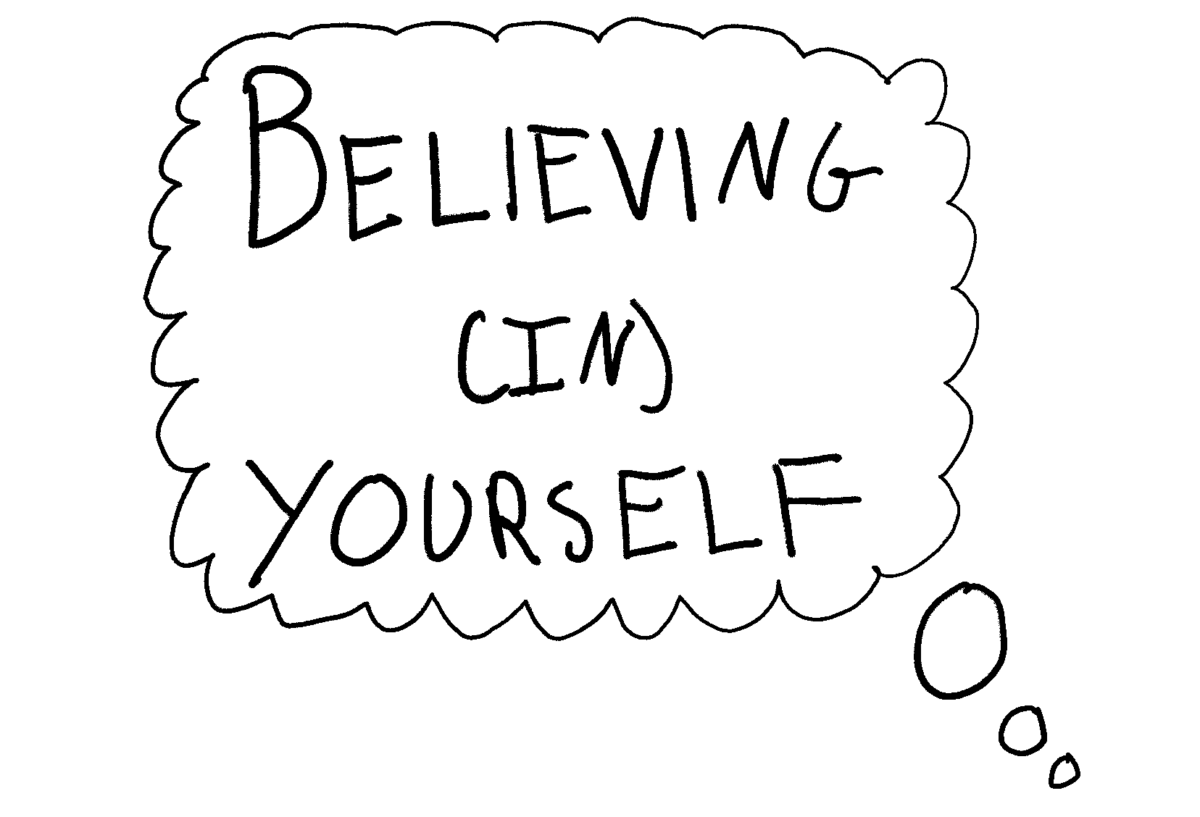
Believing in yourself sounds like a positive thing. To me, it brings a mental picture of a motivational speaker shouting out “BELIEVE IN YOURSELF” with thousands of people nodding their heads and clapping their hands ecstatically as if it’s the best thing they ever heard.
And yes, believing in ourselves is usually a good thing. If we don’t believe that we can do what it takes, it can stop us from taking on challenges, like in this piece I wrote on self confidence.
But what about “believing yourself”? In other words, believing that what we think and what we feel is always the truth?
Believing yourself?
There’s a crucial difference between believing in yourself (e.g. “I believe that I can achieve difficult things if I set myself to it”) and believing yourself (e.g. “My thoughts are the truth”).
Recently, I have begun noticing that there are many situations where I shouldn’t trust myself. For instance, every time there is an exam period, I go through the same feelings:
- A few weeks before, I think “I’ll probably get it done without too many problems”
- When I start studying for the exam, I’m usually a bit overwhelmed, but still have my hopes up “this will probably be okay”
- The last few days before the exam, I always think “oh no, I will never learn this properly. I’ll probably end up failing”.
- I attend the exam, and things (almost always) go fairly well
When I transition from step 2 to step 3, I have started to realize that I should not believe myself.
Don’t always believe yourself
The thing is: I’ve had the same cycle of thoughts many times before, even though they are proven wrong.
Just because it feels like I’ll never end up passing the test and I’ll probably fail, it doesn’t mean it’s true.
Or, when I go through the candy-isle in my local supermarket and that little voice in my head says “Buy some candy – it will be great!”
Even though I have the thought, it doesn’t mean I believe it.
Thought patterns
When I get close to the exams and start thinking “Oh no, I’ll probably fail” I stop for a few seconds and realize “That’s just that old thought pattern”. I could probably work on removing it, but for now, ignoring it is easier.
Many times, we have the mistaken belief that “because I am thinking it, it must be true”. By realizing and pointing out the times that our beliefs are mistaken, we can take away its power. Like watching a horror movie – it feels frightening, but it’s okay because deep down we know it isn’t real.
Take the next step
Knowing that my fears are not always a reflection of reality has also let me to take up challenges I wouldn’t feel comfortable taking on otherwise. Realizing that when I look up at a big goal and think “This will never work out”, it’s probably just my mind playing tricks on me.
The thing is: We usually don’t have to believe in something to act on it. Sometimes, we just need to take the next step and then figure it out, when we get there. If we wait for the motivation or the belief to be there, we will most likely end up disappointed, waiting for the day it comes.
A method that has worked wonders for me is taking a step that makes it impossible for me to quit. It might be inviting a friend to do a workout, for instance. If you cancel, it will have an effect on him or her.
How I created an event for 100 people
Between high school and university I had a year off to work and travel for a bit. At some point I decided I would create an event, Talent Event. The concept was to bring together students from talent programs from all over Denmark to facilitate networking.
I wasn’t sure how I was going to bring in 100 people to the event, but I knew that I wanted to do it. The next thing I did was to contact Microsoft in Lyngby and ask them if they could get me a room for 100 people.
At this point, I had zero signups. I hadn’t put together the curriculum. I had no crew to help me create the event.
After Microsoft (luckily) agreed, I had to find a way to make it work. I had to create the curriculum, because otherwise I’d stand there silently for 3 hours.
I had to get a crowd of people to sign up, because otherwise I’d be presenting in front of 3 people: me, myself and I.
The event ended up going great with 100 participants and 3 hours of knowledge exchange. And if I hadn’t started out by contacting Microsoft, it most likely wouldn’t have happened.
But to get back to the point: Not everything we believe is actually remotely close to being true. Sometimes, we just have to ignore our negative thoughts and get things done anyways.
