Many people start a blog, but it’s a minority who actually keeps it going over time. There are thousands if not millions of abandoned blogs with 5-10 articles on them. Showing off the goals and aspirations of its author who has since moved on. Like a graveyard of broken dreams.
I want to avoid that fate. How? Learn from the best.
To understand the journeys of different writers I admire, I went through their blogs and analyzed how many articles they had written in a given year. The results will be shown in this article.
These people are masters of their field, and their ways of working are something that both newcomers (like myself) and seasoned bloggers can learn from.
Using the examples of Cal Newport, Scott H Young, Tim Ferriss and James Clear, I have found that there are three things successful writers do:
- Start out strong to get feedback
- Low bar, no ceiling
- Stay consistent
1. Start out strong to get feedback
One common thread is that most bloggers who turn out successful start out by blogging often. An example is Scott H Young:
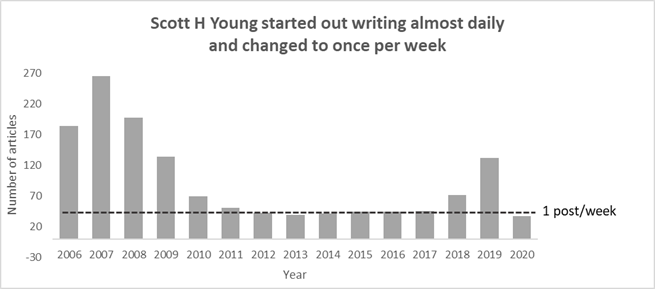
Scott started out at a mind-blowing 400+ articles within his first year. By writing a lot, he was probably able to find his voice and find a great format for his articles.
As with everything, the more you practice (deliberately, that is) the better you will become. By practicing a lot in his early days, he was able to quickly improve and to create a tighter feedback loop. Also, coming up with ideas when you are starting from an empty canvas is easier than when you have 700+ articles in the bank.
However, once he gained more success, he dialed the amount of articles down to a weekly post. Some years, like 2018 and 2019, he upped his productivity and wrote way more than that. But he practically never falls below 1 article a week.
2. Low bar, no ceiling
Tim Ferriss is one of the pioneers within blogging which started with his book “The 4 Hour Workweek”. Ever since 2007, Tim has stayed consistent and always posted at least 45 pieces of content every year:
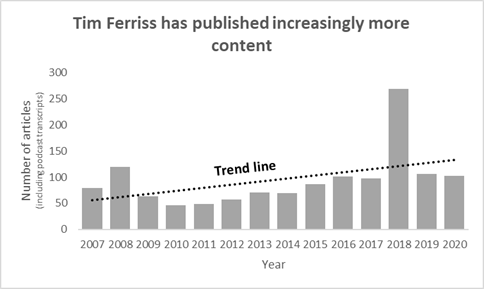
Tim seems to be applying the concept of “low bar, no ceiling”.
That is, knowing that he has to publish at least once per week, but that posting more is fine. After 2012, there has not been a single year that has had less than 52 posts – and he’s trending upwards.
If you’re starting a blog, implement the same concept: Publish at least once per week. And if one week you feel inspired, by all means, publish more. But never stray from your limit of at least once per week.
This ties in with our last point:
3. Stay consistent
To me, Cal Newport is one of the best examples of staying consistent. His first book was published in 2005. In 2006, he published his second and in 2007 he started his blog, writing 300+ articles within his first 2 years.
And the list goes on.
After that point, he published another book every 3-4 years, while keeping his writing consistent. And meanwhile, he published 110+ research papers. That’s consistency for you.
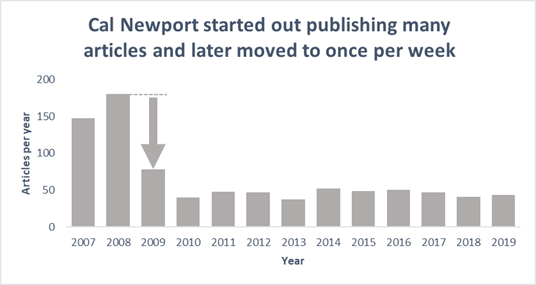
After his initial drop in 2009 and 10, there is barely any changes to be seen on a year to year basis. He stays consistent, puts in the work and publishes about 1 article per week.
No matter what life throws at him, how many books he publishes or how many scientific papers he is working on: He gets the job done.
BONUS: Writing is easy until you have success
Writing might seem daunting for some, but the mechanics of it are simple: Sit down every day and write. Once you start having success, however, that situation changes:
James Clear has an amazing blog that he routinely published on twice a week, every Monday and Thursday. For his first few years, he missed the schedule once or twice, but he stayed consistent.
In 2015, however, something changed: He signed a book deal. And that could be seen in his output of articles:
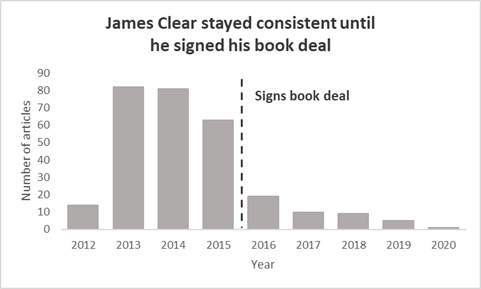
As Cal Newport said in a recent episode of Deep Questions: “[Writing] doesn’t become really hard until you succeed.”
Until you actually have people reading and caring about the pieces you write, writing does not take a toll on you. But when you are more successful, doing speaking gigs across the world, writing books and interviews, writing becomes difficult.
And that is seen time and time again in the postings of these writers: Once they begin writing books, they have a hard time consistently writing articles.
In a lot of cases, it seems to be a choice to focus on something else. In James’ case, he moved from blog posts to a weekly newsletter, describing “3 ideas from me, 2 quotes from others, and 1 question for you”.
It’s actually a bit reassuring: Before you have success, writing is an easy hobby. It doesn’t take that much time every day. Until one day it does, and then (and only then) will you have to choose whether it’s worth the investment.
Until then: Start out strong, have a low bar and stay consistent.
Wrapping up
If there’s one piece of advice that my research into these writers has shown me, it is this: Putting in the work is the prerequisite for a successful blog. It won’t guarantee you success, but it’s the foundation that any good writer builds upon.
These people were not born exceptional. Rather, as James Clear mentions in his first ever blog post: Successful people start before they feel ready.
They show up and put their work in. And slowly, results start appearing.
