
Planning your career is difficult if not impossible.
And yet, many of us have been told time and time again that we need a 5 year, a 10 year or a 20 year plan. We need to know exactly how long we are going to stay in our next job and where we will work afterwards.
But this way of planning usually does not work. Back when people worked for the same company their entire lives it might have worked. Now, the world is simply too complex, and with an ever-changing job market, planning 5-10 years into the future is usually infeasible. Luckily, there is another way.
But before we get there, let’s talk about the landscape that you are currently in. Let’s call this The Map of Work:

Based on your current location, you have a goal or a destination that you want to get to. It might be working for a specific company or having a specific position.
Step back: Why do I want this?
When we have a destination that we aspire to, it is always interesting to take a step back and think “why do I want this?”. What is it that draws me towards this goal? Usually, it is unclear why exactly we want to achieve it. It might be a goal we have had for so long that we have forgotten why we have it.
Before using our time and energy chasing a career, we need to make sure that we are doing it for the right reasons. That’s what the following exercise is for:
EXERCISE: Why do I want this goal?
Usually there is one of two reasons we want a specific goal. It is either about going towards something (“I want to be a manager”) or away from something (“I don’t want to be a developer”).
Sit down for 10-15 minutes with a piece of paper and answer the following questions:
➡ What do I hope to achieve by reaching this goal?
➡ How would it make me feel?
➡ What would it say about me that I was able to achieve it?
and conversely,
➡ What am I moving away from?
➡ What do I not want to feel?
➡ What would happen to me if I did not reach the goal?
Afterwards, read your answers through and think: Are these answers the best way of reaching your goal? If you want to feel accomplished by getting a great job, is there another, easier way of doing that?
Knowing where you want to go – and also knowing that getting there will probably not make you happy in itself – is a great first step towards finding your direction.
When we think we know where we want to go, we are often told to put down a plan, figuring out how to get there. This way of thinking is called The Binocular Method
The Binocular Method
As mentioned above, we are often told to have a 5 year plan. On The Map of Work, that is the equivalent of taking out a pair of binoculars, figuring out the direction of your goal, and then walking directly towards it.
The binoculars help you see far, but they also limit your field of view.
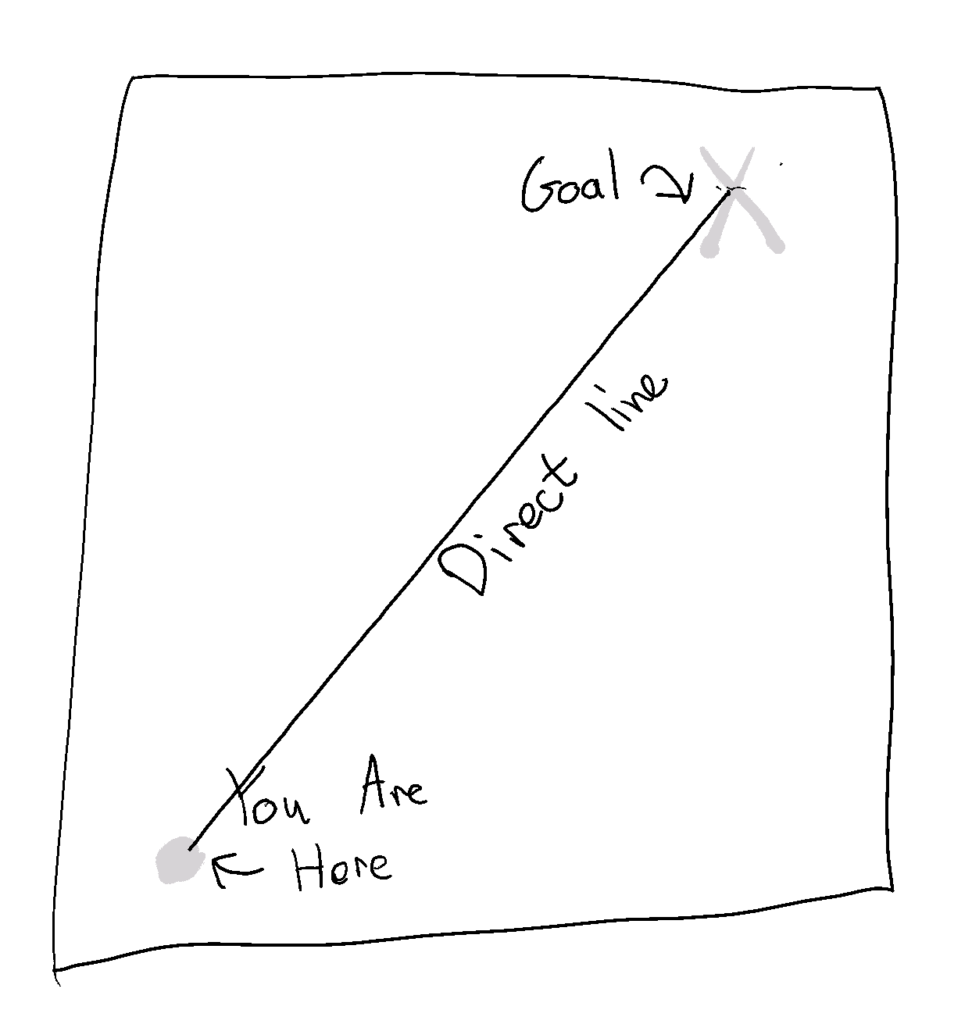
In a perfect, predictable world, using The Binocular Method could definitely work. But in the world that we live in – the real world – it is often infeasible. We simply do not know what is going to happen in the future. In terms of Systems Thinking, the world is a complex system.
If a plane takes off from Copenhagen towards new York and is 2 degrees off course, it will end up 124 miles away from the target. And the farther it flies, the more off target it becomes.
This is why planes constantly adjust their direction to ensure that they are on course. And that’s the exact same thing that you are going to do.
The 35-Degree Method
Instead of trying to nail your direction completely from the start – newsflash: You probably can’t – we should instead find a general direction that is probably right. Then we can adjust the course accordingly.
Let’s call this The 35-Degree Method:
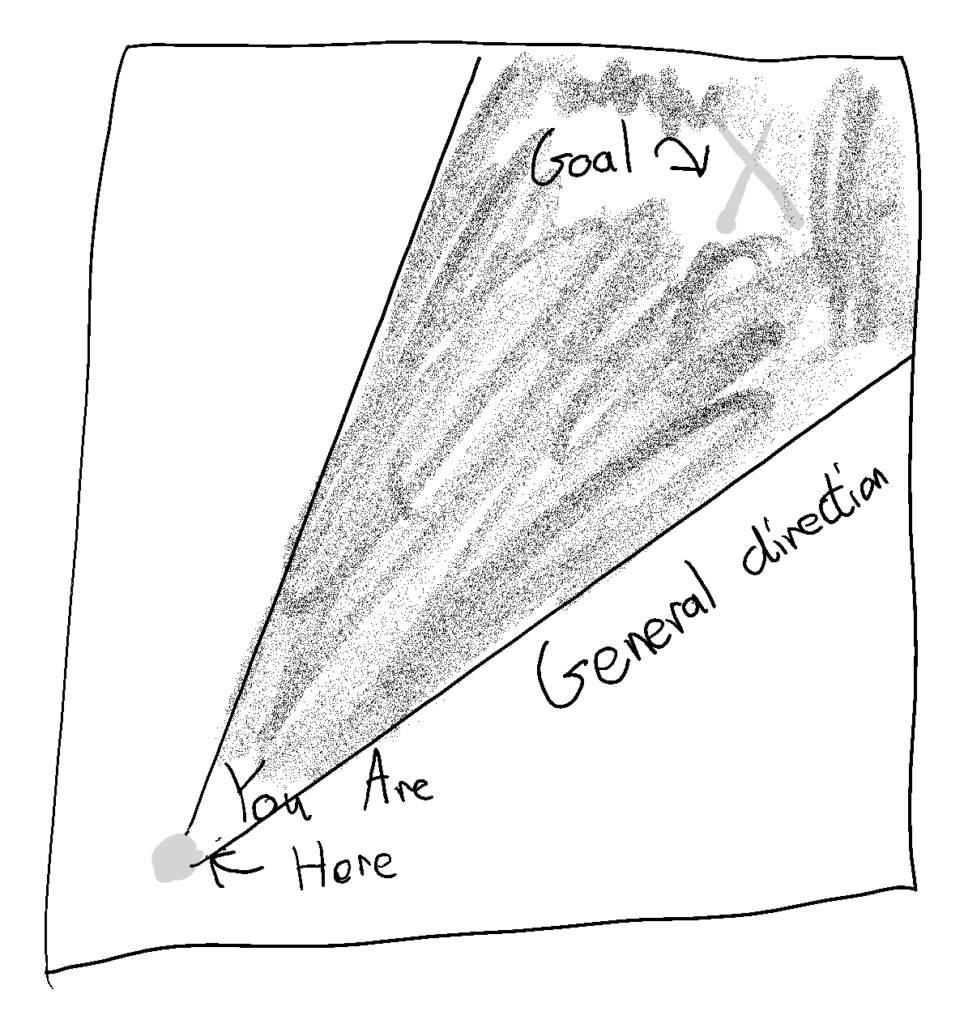
Using the 35-Degree Method means to figure out some criteria or general principles that you can use to navigate in your career. When given a choice, you can use these principles to make a choice that is probably right.
Plus: As you get farther on your journey, you will have more knowledge about what your next step should be.
Examples of principles could be:
- Build rare, valuable skills (Career capital, as Cal Newport phrases it)
- Work with people who are smarter than you
- Make sure that I learn new, exciting things that will be useful in the future
- Work somewhere that makes you excited about going to work
If you go through your whole career with the above principles in mind, making choices based on them, everything will probably be fine.
Stopping over-optimization
This way of thinking is liberating to me. It keeps me from trying to optimize everything, and lets me focus on what the next step is. Not trying to find THE BEST next step, but a step that will move me in the right direction, nonetheless.
And if we find out that where we are going is the wrong direction – if the job is not actually fulfilling the criteria above – then we can take a step back and find something else.
