When it comes to our careers, making choices is difficult. It’s especially difficult to figure out what the “right” choice is.
Mostly because there is probably no such thing as a “right” choice.
It is not always better to be a consultant rather than a software developer. Or to work for Company A vs Company B.
And because it’s relative, many people latch onto the few rankings and ratings that exist. A great example is within consulting.
Insecure overachievers
When talking about the perfect consultant, the term insecure overachiever is often used. An insecure overachiever is:
Exceptionally capable and fiercely ambitious, but driven by a profound belief in their own inadequacy
Laura Empson
It is someone who is driven to perform because they hope that it will give them a feeling of significance. I am one myself – and I know that it can be incredibly unhealthy. For the company, however, it can be great: It lets you crank out a lot of high quality work in a short amount of time.
For the short term, if output is important, then all hail the insecure overachiever.
Success does not last
Unfortunately, The Law of 7 indicates that achieving good results will never be enough on its own to make the insecure overachiever feel good about themselves.
It probably won’t suppress a fundamental feeling that you are not good enough. It will only keep it down in short periods of time. Like peeing your pants in the middle of winter: You feel warmer for a bit, but you end up worse.
You end up chasing the proverbial dragon, constantly thinking “if only I achieve this, THEN I will feel successful”.
EXERCISE
For all my fellow insecure overachievers, here’s a quick exercise: Think about a point of time where you achieved success. How did you felt before, during and after the success? How did you feel a day later? A week later? A year after?
If you are like me, you will notice that after a few weeks, our lives are back to normal.
It’s even an inside joke on consulting forums:

It is not surprising, then, that a lot of consultancy firms market themselves based on their own status – and implicitly the lower status of their competition.
For insecure overachievers and applicants desperate to feel like they “have made it”, a brand of being the best is worth its weight in gold.
Note: Of course, not all people working in consulting have those issues or are insecure overachievers. There are many who just love the way of life and the exciting tasks – and that’s ok.
The best consulting firms
If you visit r/consulting on Reddit, you’re hit with the following message in post after post:
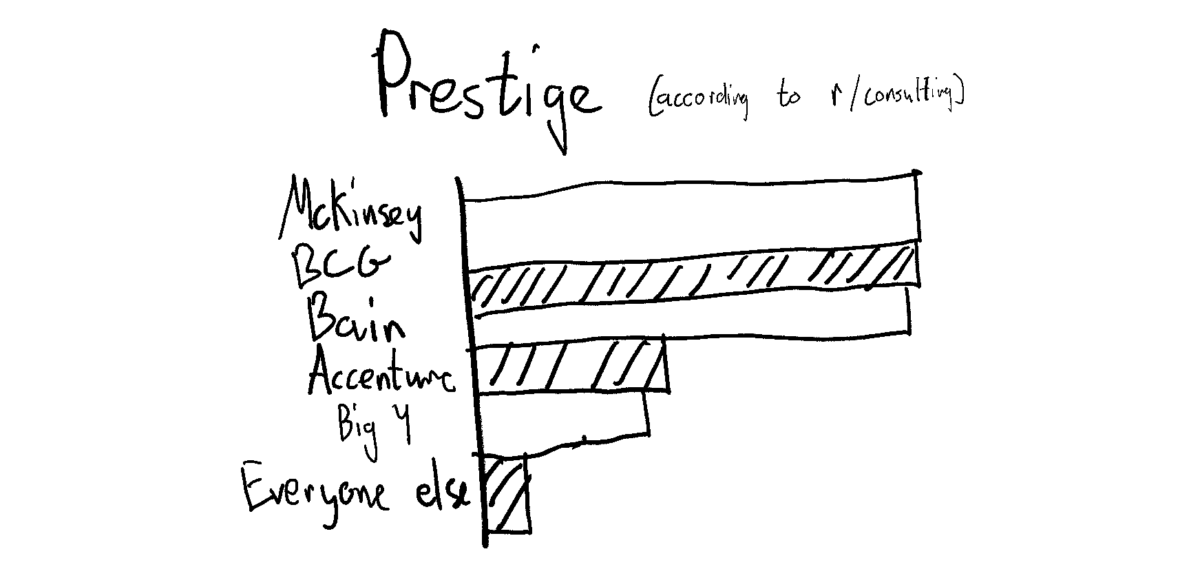
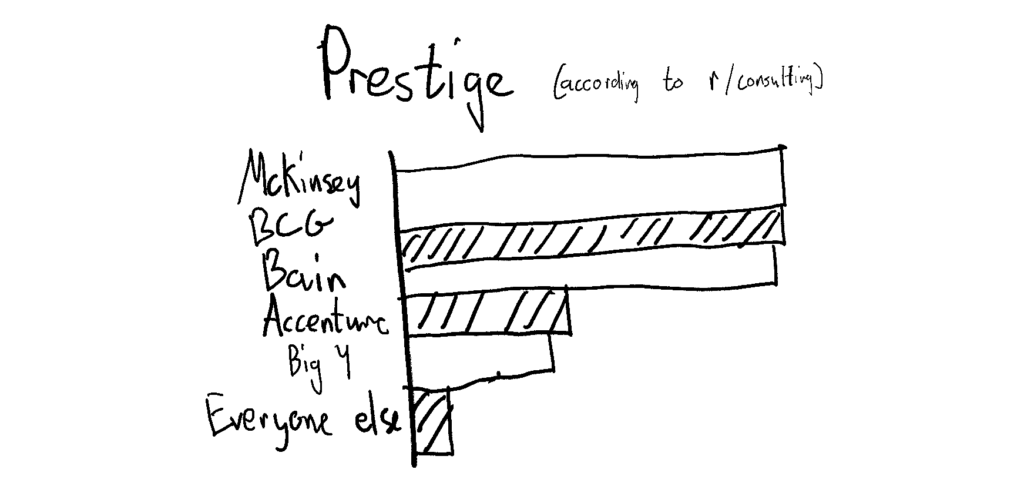
“You are a failure if you are not working within MBB (McKinsey, Bain and BCG)”
You might have heard this so many times that it seems like a fact. But at some point, someone (probably working in marketing for a MBB-company) has decided that they are “tier one”. And everything else is “tier two”.
According to that view of the world, prestige is distributed as follows:
fired from most consultancies in seconds 🙂
Everyone should have the same criteria for choosing a job and what gives them a fulfilling career, it says. If it’s not MBB, then it’s worthless, it says.
When we have no other criteria
The other day, I found myself scrolling through graduateships.com and their list of the “Top 50 Consultancies”. Based on some – more or less arbitrary criteria – they have ranked the “Top 50 Danish Consultancies”.
I was looking into which firms to apply to, and the list seemed useful. But really: What was useful about it?
I realized that the list was not useful in itself; I could not care less if the company I worked for was #4 or #37 on the list. But because it was some (arbitrary) ranking that I could use to determine success.
Because I had no other mental rankings to use, I used what was available.
Prestige (and success) is relative
The true level of prestige/success of working at a given company is more complicated than a simple ranking.
Some people probably despise your favorite company while others love it to death. Simplified, the actual level of prestige might be:
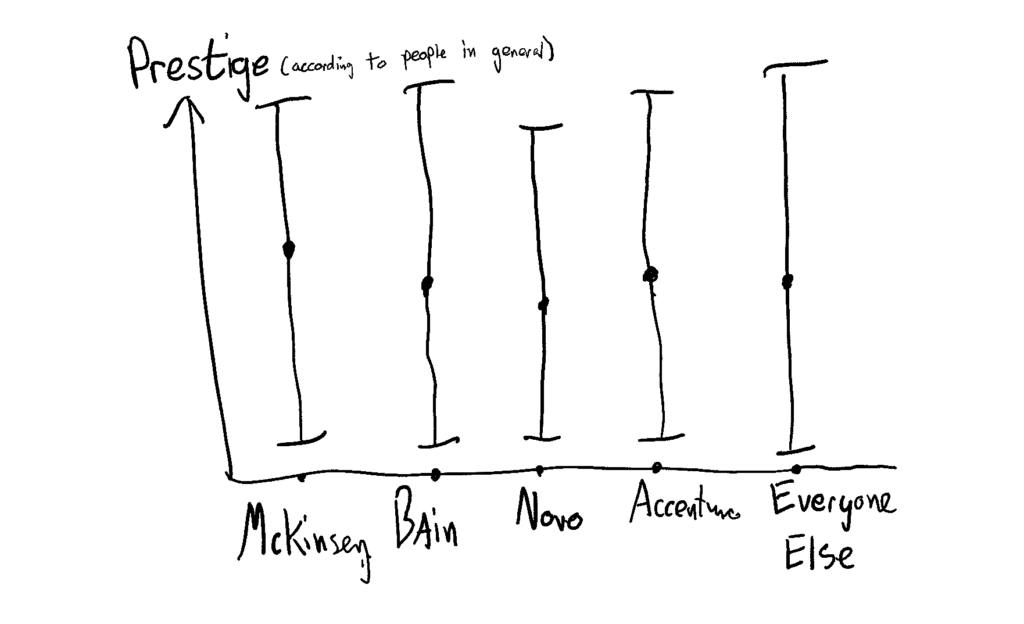
And in other subcultures or fields, companies like Goldman Sachs, Ørsted or Netcompany tops the list.
Again: There’s no universally “right” choice.
Forget the list
So instead of focusing on the position on a list, to feel like we have “made it” by getting into a prestigious firm, let’s find some other criteria to choose the companies based on.
The criteria might be:
- Do I feel happy going to work?
- Am I learning hard-to-obtain and valuable skills?
- Is there upward mobility and strong role models?
- Do I enjoy my colleagues and are there people smarter than me?
