
A few days ago, Google told reporters that they were disrupting the universities. How? By creating three 6 month courses in Project Management, Data Analysis and User Experience. The would be “the equivalent of a 4-year university degree”. At least, according to Google themselves.
But can it really be true? Can Google create a course that is 8 times as effective at teaching the things that college teaches? (6 months vs 4 years)
As we will see in this article, the answer is: Probably not.
What you learn at university
When asking former university students about what they have learned, one thing stands out: It isn’t just linear algebra, how to research and write papers. It’s something more subtle: They have learned how to learn.
By being exposed to different courses with highly complicated and specialized knowledge, they have learned how to sit down and acquire difficult skills. Time and time again.
Learning something valuable is hard work. That’s why I’m extremely skeptical about online courses that don’t require hand-ins and hours of deep thought. The classic certificates we see on LinkedIn that require a 4 hour video course and a multiple choice test (that you can re-take if needed) is borderline useless.
“But”, I hear some of you thinking, “what about highly specialized skills? Does it even matter whether or not I have a broad overview of the field, if I’m not going to use it?”. The answer is: Of course it does.
Receiving training in just project management is like only teaching a carpenter how to use a hammer. If the task you give them is hammering nails, then they will succeed. But the second the tasks exceed what they are taught, things become difficult.
For a university student, their frame of reference is way larger: They have simply learned more about things that are similar to the problem at hand. To stay with the metaphor, they might not be experts in hammering nails, but they have used a hammer previously and know when to use a saw instead. If there’s a problem, chances are that they will know how to solve it – or, at least, how to learn how to solve it.

Unknown unknowns
Another issue with thinking that a 6 month certification is all you need is the concept of unknown unknowns. In short, there are four categories of knowledge:
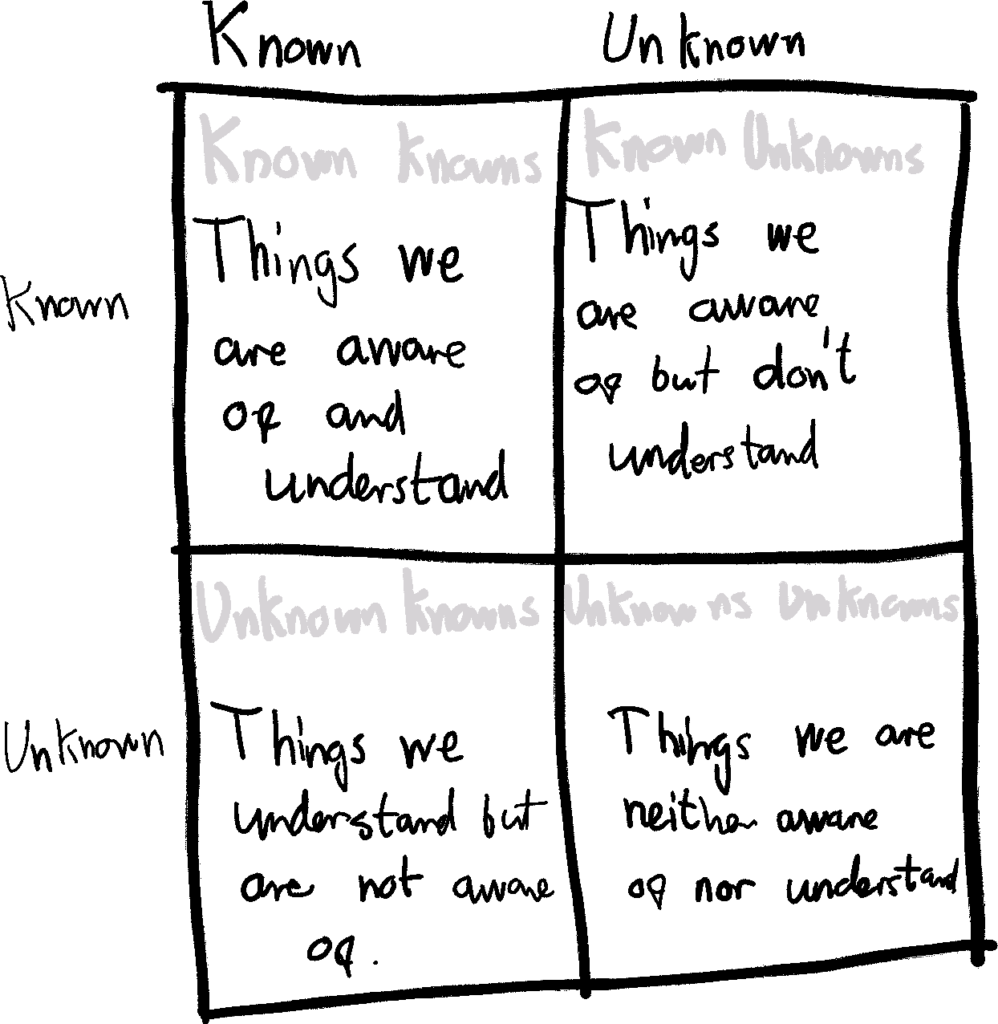
When you are taught to zoom in on the practical skills, you will end up with a lot of unknown unknowns. Things that you don’t know that you don’t know. You’ll be taught a tiny sliver of the entire field – and you probably won’t know what you’re missing out on.
While, if you are studying at a university, you will most likely end up with known unknowns. You will get a brief understanding of an entire field and know which subjects you know little about.
Universities make it easier
Even if you were to get an overview of the things that you don’t know, actually acquiring the skills is difficult. Here, there are quite a few things about university that makes it easier: You have:
- A peer group, learning the same things
- Projects to test out your skills
- Professors teaching you the subject
- TAs helping you understand the things you’ve missed
- Exams that force you to actually acquire the skills and knowledge
Am I saying that learning linear algebra is impossible to do by yourself? Of course not, but the chance of you 1) knowing that you need to learn it and 2) actually being able to learn, it is slim.
Plus: The difficult part about being a data scientist is not necessarily to mangle the data in order to make it useful: It’s to have the knowledge to know what the data can be used for. And the only way to get that is to have a solid, theoretical understanding.
Stuck in a low-skill job
If Google chooses to hire you because of the certificate, there’s a good chance that the tasks you will be given are low-complexity. After all, you have only spent half a year learning how to perform your job.
Scenario: You are moving to a new place and need a friend to come over to help you carry furniture. One of your friends has been weightlifting for 6 months, the other one for 4 years. If you know nothing else about them, who do you choose?

The answer is clear, right? For some reason, our intuitions are different when it comes to education. But almost no matter how badly you trained for those 4 years, you’ll be stronger than someone training for 6 months.
If you perform deliberate practice, you will become better at something. And the more you practice, the better you will become.
Becoming locked-in at a company
Let’s say that you take the certification and get a job at Google. I doubt that this will happen for even 1% of the graduates. But anyways, congratulations!
After a while, you might want to transition to another company. The issue is: Google is one of the only companies who will see their certificate as the equivalent of a 4 year degree. To all other companies, you will be an ex-Google with a certificate.
The way Google’s brand is right now, that might be able to set you up for good. But a serious worry is whether or not that will keep on being true. If Google starts churning out low-skill workers, there will be an implicit categorization: Were you in tier-one or tier-two Google?
I’m worried that Google will end up creating one-trick ponies and keep them working for Google at sub-par wages because Google is the only one valueing their degree. And when the options are: Go back to a low-paying job or stay at Google’s (comparatively) high-paying job, then you’re stuck.
If we look behind the scenes, that’s what Google might be doing: Creating a larger possible workforce to help them long-term. Remember: Google is not a charity. At the end of the day, it’s not about you, it’s about supporting Google.
Coding Bootcamps
A great analogy of the certification that Google provides is the coding bootcamp. Intensive, months-long programs that have the aim of teaching students how to code, giving them a chance to get into programming.
These bootcamps are often marketed as alternatives to university. However, in reality, most of the participants (76%) already have a bachelor’s degree, according to this study. Therefore, they are not actually an alternative to university. Rather, they are an add-on to improve within programming.
Furthermore, most coding bootcamps are in-person and are located in the areas that already have the highest proportion of IT and developer jobs. Therefore, they seem to serve a very small part of the market: Those that are already in these affluent areas.
To top it off, their admissions progress is complex and lends itself well to those that will be used at technical interviews with companies. This creates a huge selection bias, which makes you wonder how many of the participants would have gotten a job anyways.
Wrapping up
The Google Career Certificates are like a coding bootcamp for education. They will end up as add-ons, used by those trying to transition into project management, data analysis or user experience. And that’s a perfectly good use case, especially if the universities continue to be prohibitively expensive to a large group of people.
What a 6-month online course is not – and will never be – is the equivalent of a university degree. If your choice is between university and Google’s certification, your choice is clear: Go for the university education.
